Using furloughs to reduce costs during a business slowdown is a common strategy, but in China it is strictly regulated. Under the law, operations must have genuinely stopped, and certain business transactions can result in wrongful furlough liability. Thus, businesses must adequately document that they acted in good faith to reduce payments in this manner; otherwise, they are at risk of expensive lawsuits. In this CBL explainer, we will explain China’s law on furloughs and recommend best practices and risk controls that can enable you to make effective decisions.
Contents
- Legal Test for Furloughs
- Wage Payments During Furlough
- Planning and Filing Procedural Compliance
- Contingency Planning for Risk Management
- Business Resumption Planning
Legal Test for Furloughs
An employer must pay regular wages if work is suspended within a payroll cycle for reasons not attributable to the employee, and pay at least the local minimum wage if the worker performs regular work after one payroll cycle. (See China Wage Payment Temporary Rules § 12) The company will need to determine the legality of its wage payment plan by applying the rules to its conditions.
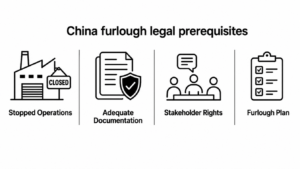
Chinese law does not provide a legal concept or test for furloughs. Based on an ordinary meaning interpretation, the term refers to the event in which operations are suspended because the employer cannot provide working conditions or assign work to employees. It is a business decision based on business conditions and falls within management’s prerogative.
Courts in judicial precedents apply a strict legal test. Employers must provide competent evidence showing a need to substantially suspend business operations due to operational difficulties, technological upgrades, workplace safety upgrades, or business restructuring. If the employer has not actually suspended operations and has only made partial adjustments or temporary reforms, it is unlikely to be deemed a furlough under China Wage Payment Temporary Rules § 12.
Courts’ legal test and substance-over-form analysis follow these review priorities:
- if the company’s operations and core business have been suspended;
- if the company has operating revenue;
- if the company has stopped issuing receipts, or receipts are issued only for winding down;
- and if the entire company is under furlough.
The legal test requires documents such as board or shareholder resolutions, furlough notices, customer communications on contract termination or cancellation, and other evidence that the company has in fact ceased operations, including operating plans and business cash flow records.[1][2][3] Before the furlough process starts, make sure that your documentation and plan are in order. If you need help with these kinds of employment issues in China, take a look at CBL’s legal services page.
Wage Payments During Furlough
The “one payroll cycle” under the China Wage Payment Temporary Rules § 12 can be interpreted as the employer’s regular wage calculation period or the first month after the furlough decision. Absent a specific definition in law, both interpretations can be deemed reasonable. After the first payroll cycle, the employer and employee may agree on a new wage rate for regular work not lower than the local minimum wage.
If no work is assigned, the employer must pay living expenses, at least 70% of the local minimum wage in Beijing and 80% in Jiangsu and Guangdong. Most other regions follow similar standards, while Shanghai requires no less than the local minimum wage.[4][5][6][7] Employers should determine furlough wage payments based on applicable local law and cases.
Planning and Filing Procedural Compliance
Implementing furloughs lawfully requires the entity be eligible and maintain strict procedural compliance. Although the law requires no specific procedures, courts may, on strict review, treat it as a major matter affecting employees’ interests under China Employment Contracts Act § 4. Under the Act, employers must negotiate with the labor union or all employees and notify them before deciding to suspend work. The steps are:
Prepare a furlough plan that states the reasons for suspension of work, the scope, wage standards during suspension, resumption conditions, and workforce reduction plan. The affected employees should not be selected in a targeted or punitive manner. For example, if the employer places individual employees on standby while operating normally, the courts may not recognize it as a furlough.[8]
Negotiate with employees by submitting the furlough plan to the union or employee representatives for discussion, then consider their opinions and suggestions. For companies without a union, the process may proceed through a meeting of employee representatives or a meeting of all employees. Employers should keep written records of the process, including attendance sheets and voting records. If necessary, the entire process may be documented by an audio or video recording.
Adopt the furlough plan through the appropriate company authority, such as the shareholders’ meeting, board of directors, or president, and notify all employees of the final plan internally through forums or automation systems. If necessary, enter into a standby agreement or issue a standby notice to provide for compensation and arrangements for the standby period.
File with the appropriate government agencies if a filing is required before commencing a furlough. The specific requirements differ across regions. Where filing is just an administrative procedure, failure to complete it does not necessarily render the furlough unlawful or prevent the company from applying the wage payment rules during furlough periods under the China Wage Payment Temporary Rules.
Contingency Planning for Risk Management
Manage conflicts between employee standby status and protected leave. Furloughs may continue for extended periods and may overlap with periods of protected leave, such as annual leave, sick leave, or maternity leave. Determining the applicable wage payment standard during such an overlap is therefore an important risk for employers. Judicial precedents indicate employers should treat cases differently depending on whether the furlough or the protected leave begins first:
Employees are not obligated to continue working if the furlough begins first, so the standby status does not affect the reason for taking protected leave. The objective conditions justifying protected leave continue to exist for the employee. Therefore, some lawyers believe the employer must pay wages under the furlough-period standards.
When a period of protected leave begins first, courts hold that wages should be paid under the applicable protected leave standards.
Does a furlough lasting over one payroll cycle affect the calculation of the employee’s average monthly wage? The furlough rules cover compensation when the employer has suspended employees’ work, with the legislative intent to balance employer and employee rights. Once a furlough extends beyond one payroll cycle, however, the rules allow employers to pay only a living expenses, which is substantially lower than regular wages. This is useful for circumventing the China Employment Contracts Act’s strict wage payment requirements. Furloughs followed by layoffs are now common. Disputes center on whether living expenses paid during furloughs extending beyond the first payroll cycle should be included in the calculation of employees’ average wage.
Previously, Labor Circular No. 481 provided that severance should be calculated based on the employee’s average monthly wage during the 12 months preceding termination in normal operations.[9] Furloughs do not constitute normal operations, so they must be excluded from the calculation.
After Circular No. 481 was repealed in November 2017, the issue became even more hotly contested.[10] One approach is that, although Circular No. 481 is no longer valid, furlough periods should still be considered atypical operating periods, and living expensies paid during such periods do not reflect an employee’s regular wage level. Therefore, the Circular No. 481 requirements may still be followed in the absence of a superseding law or rule. Another approach is that the China Employment Contracts Act § 47 applies following the repeal of Circular No. 481. Under § 47, the employee’s monthly wage is calculated based on the employee’s average wage during the 12 months preceding termination or cancellation of the employment contract. Living expenses paid during furlough periods under the China Wage Payment Temporary Rules § 12 are legal, so they should not be excluded from the calculation.
Some courts favor the first approach, because the calculation method under Circular No. 481 § 11 remains reasonable even after its repeal. A similar approach was upheld in recent cases concerning whether sick leave should be excluded from wage averaging before termination.
For example, in Jiangsu Case 0508-cv-164 (2019), the trial court granted the employee’s claim, stating that “severance differs from punitive damages in that it compensates employees for losses and reflects the employer’s social responsibilities. Accordingly, severance calculation should exclude periods of protected leave such as sick leave and maternity leave and should be based on the employee’s wages during normal working hours.”[11]
Labor regulators, arbitrators, and judges retain considerable discretion in these disputes, and local enforcement approaches and judicial policies vary significantly. Employers should confirm the local rules to avoid surprises when addressing disputes like these.
Business Resumption Planning
Companies experiencing poor business conditions should not rush to stop work. Instead, start by assessing options such as partial suspension or reduced work hours. If furlough lasts longer than one payroll cycle and employees continue to perform regular work, they must be paid no less than the local minimum wage. (See China Wage Payment Temporary Rules § 12) Partial suspensions can preserve essential business functions and invoicing, while reducing the risk of the furloughs being rejected because there has been no substantive suspension of work.
Doing so prevents the arrangement from being misconstrued as the “furlough followed by layoffs” fact pattern. A business resumption plan should be prepared during the first payroll cycle and should outline the recovery benchmarks and recall conditions. The board resolution, client communications, and business resumption plan should be documented.
Management should treat furloughs and layoffs as separate decisions. If recovery is impossible within the first payroll cycle, you should initiate layoffs under the China Employment Contracts Act § 40 or 41 and pay severance, rather than trying to reduce termination costs through prolonged minimum wage payments. Otherwise, courts applying the principle of good faith may find that the furlough is intended to reduce termination costs and grant employees’ claims for full severance based on the employer’s failure to provide working conditions. Internal communications should be consistent and should precede external communications.
You should clearly explain to the employees that the furlough is temporary and introduce the resumption plan. Where necessary, a standby agreement can be signed to provide for the monitoring and review process and prove that the furlough serves genuine business purposes and is not targeting certain employees. You’ll get better results by having an expert oversee a furlough process.
Conclusion
A furlough is a last resort for employers in crisis, and its legality involves a substance-over-form analysis, procedural compliance, and risk management throughout the process. You must comply with the law and document everything to protect employee rights while maintaining business operations.
Generally, major employment decisions such as furlough require expert advice. If you need help with these kinds of employment issues in China, take a look at CBL’s legal services page.
FURTHER READING
Get more insights about Chinese employment law:
FOOTNOTES
[1] Shanghai Case 0115-cv-22468 (2020), (2020)沪0115民初22468号, (Shanghai Pudong District Court, Jun. 30, 2020), in Mandarin
[2] Guangdong Case 01-cv-32839 (2023), (2023)粤01民终32839号, (Shenzhen Lower Appeals Court, Jan. 12, 2024), in Mandarin
[3] Guangdong Appeals 11136-cv-11146 (2020), (2020)粤民申11136-11146号, (Guangdong Upper Appeals Court, Nov. 6, 2020), in Mandarin
[4] Beijing Wage Payment Regulations, 北京市工资支付规定, (Beijing City Government, Dec. 22, 2003), in Mandarin
[5] Jiangsu Wage Payment Regulations, 江苏省工资支付条例, (Standing Committee of the Jiangsu Province People’s Congress, May 27, 2026), in Mandarin
[6] Guangdong Wage Payment Regulations, 广东省工资支付条例, (Standing Committee of the Guangdong People’s Congress, Feb. 24, 2017), in Mandarin
[7] Shanghai Wage Payment Procedures, 上海市工资支付办法, (Shanghai Human Resources and Social Security Administration Jul. 17, 2026), in Mandarin
[8] Guangdong Cases No. 4513 and 4514 (2019), (2019)粤民申4513、4514号, (Guangdong Province Upper Appeals Court, Aug. 13, 2019), in Mandarin
[9] Ministry of Labor Employment Contract Violation or Termination Severance Payment Procedures, 违反和解除劳动合同的经济补偿办法, (Ministry of Labor, Dec. 3, 1994), in Mandarin
[10] Ministry of Human Resources and Social Security Circular on Abolished Documents #5 (Ministry Circular No. 87 (2017)), 人力资源社会保障部关于第五批宣布失效和废止文件的通知, (Ministry of Human Resources and Social Security, Nov. 24, 2017), in Mandarin
[11] Jiangsu Case 0508-cv-164 (2019), (2019)苏0508民初164号, (Jiangsu Gusu District Court, Apr. 2, 2019), in Mandarin