According to major news outlets, well known footballer famous throughout China with many celebrity endorsements, Kylian Mbappé, was banned in China over a faux pas. What did he do? He said that Mao Zedong is a “Chinese dictator.” This particular story resonates with me because, just two months prior, I predicted this exact controversy and urged language industry professionals to take steps to stop this vicious cycle.
The problem is bizarre enough and big enough that, anyone engaging with the topic of China—not just China itself—should get expert advice before attempting to navigate the Byzantine maze without falling into a trap, as Mbappé did.
I’m one of the few people who have work experience in how China communicates its own history to the world, having worked with several historians, and helped produce the international version of Yi Zhongtian’s feature Three Kingdoms film. So, I know just how difficult and complicated this sort of problem is to address, having worked through many before. Thus, when it came to China’s history, I was well aware that ordinary readers are being confused and misled, and for high-profile individuals, this confusion can lead to full economic bans.
The Trap and Vicious Cycle
The vicious cycle is relatively simple: China’s legal translators consistently call China a dictatorship, and its political translators consistently deny China is a dictatorship, and claim China’s feelings are hurt when that is done. In the middle is a foreigner, trying to play it safe, simply parrots whatever China said about China. Nonetheless, the parrot is severely punished for having parroted. Here, the parrot is Mbappé.
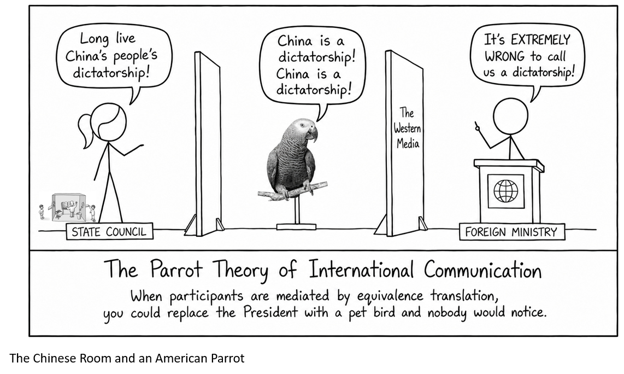
While this sounds completely absurd, there’s a good explanation for this: in China, English is not a language people are using to communicate with each other; it’s a technical domain following specified design patterns. There is a central English language regulator that has issued rules for English, where each word in existing English is mapped onto a Chinese word, and an English language is constructed according to Chinese.
In this case, the two words are ducai and zhuanzheng, both of which are translated to ‘dictatorship.’ Historically, Marx and Lenin did advocate dictatorships, and Mao Zedong initially adopted those ideas, however he developed a distinctively Chinese Communist theory, which rejected much of Lenin’s ideas. A key difference was, Lenin believed that industrial workers, making up perhaps 10-20% of the population, would seize control of the country within cities, and characterized farmers as petit bourgeoisie.
Mao Zedong on the other hand, developed a theory of Communism where peasants, workers, and soldiers would unite as three classes all constituting proletariat, to overthrow what then had become a plutocracy. China’s rural areas developed differently from Europe; the shidafu scholar-official elite used centralized power to enable 1% of the population to hoard 30% of the wealth. He explicitly said this would constitute 90%+ of the population, rejecting Lenin’s minority-control theory of dictatorship. This “zhuanzheng” for Mao really meant exclusive governance by the proletariat, free of manipulation and corruption implied by the plutocracy.
This is especially clear since “zhuan” means “exclusive” and “zheng” means “governance, and that’s literally what a dictionary says in it. The reason they say “dictatorship” is that someone matched this concept up with its historical lineage, without considering whether people would really understand what Mao was trying to say.
This is the same narrative that Chinese propagandists tell domestic audiences, but nonetheless something almost entirely lost in translation. We know it’s lost in translation because this kind of narrative would be incredibly popular in Western countries, where activists are repeating almost literally the same things Mao Zedong said.
The word zhuanzheng in Chinese is also close to the word zhuanli and has the same root. It’s a very ancient word with ancient Chinese historical connotations. In ancient times, the Emperor was granted a divine right to rule by Heaven, and as part of China’s unwritten constitution, was bound to fulfill the needs of his people, otherwise Heaven would see to his overthrow. The Emperor had a zhuanzheng to rule, one could say that he had a patent to rule, an exclusive right over government, much like how a patent gives exclusive right over a technology.
This is the tradition Mao Zedong drew upon, in his secular theory that it is popular sovereignty, minzhu that gives the Communist Party the right to rule, not Heaven. Minzhu is translated as “democracy” despite that min means popular and zhu means sovereign, very literally. So, Minzhu Zhuanzheng is really saying, “exclusive right to rule derived from popular sovereignty.” This mirrors the ancient Chinese divine right to rule granted by Heaven, and it’s also consistent with saying that for example gerrymandering in a democracy, is undemocratic.
Speaking English to China Means Speaking Mandarin
A neuroscience study in 2023 of Chinese bilinguals, even found that when speaking Chinese, locals’ brains are actually processing it in Chinese, and processing all English words on the fly. This means it’s possible for people in the language to say things that are self-contradictory without noticing: if the Chinese is not self-contradictory, and it’s not in the ‘dictator’ case, then there isn’t a problem even if the English isn’t self-contradictory. The study also implies, if you are speaking English to China, you are really speaking Chinese, which means without expert advice you’ve lost control over what you are saying.
Some of you who are familiar with my talks in China may have noticed my neuroscience lectures published on the Chinese internet by universities from before the publication date, with the picture of the brain. There’s an important story implied here: I was working on this exact issue at the time and involved with many scientists trying to untangle these problems.
In this sense, when you say “dictatorship,” the translation mapping goes to “exclusive governance” and when you say the same thing, “dictator,” it maps to “one person alone rules”. For an English speaker, a dictatorship has a dictator, but that doesn’t apply when engaging with China.
A complicating factor is that many social media influencers outside of China do in fact argue China is a dictatorship in the “ducai” sense, and they often take statements by celebrities and government leaders back translated to English to support those claims. After back translation, these social media influencers are using the celebrity to endorse a very explicitly anti-government position that the foreign individual never intended. Often, they imply that evidence censored in China was read by these foreigners abroad, who discovered the truth in it, when the reality is that they simply read and repeated a mistranslation.
For example, influencers showed clips of Joe Biden arguing that the fact China is a Communist “dictatorship, that therefore that Xi Jinping is a “dictator.” Biden was actually citing documents still on the Chinese government’s website characterizing the country as a “dictatorship.” To Biden, the truth seemed extremely obvious, a dictatorship has a dictator. The neuroscience paper says, to a typical bilingual Chinese brain, dictatorship and dictator are two radically different things, polar opposites in fact, one does not imply the other; a dictatorship implies the absence of dictators.
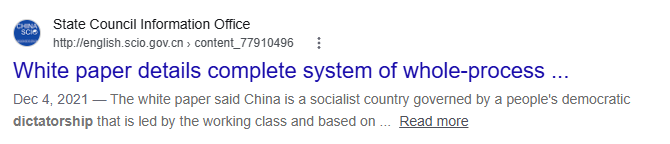
For a celebrity or CEO, this explains many highly unexpected China social media bans.
China’s ESL-Industrial Complex is Too Big
This all seems very straightforward, so a question is, why are there never-ending controversies over basic semantic questions? The reality behind the Mbappé headlines is that China has an ESL-Industrial complex that’s so large it routinely malfunctions. The industrial complex here means, English is not used as a natural language of interaction in China, it’s used as a technical translation discipline to interact with people not from China. There is an underlying engineering discipline being used, called Ontology Engineering (https://en.wikipedia.org/wiki/Ontology_engineering).
Academic studies in Hong Kong found in the 1990s, the process was used to “engineer” a legal language for Hong Kong. This originally British process was transplanted directly to China for its interactions with the English-speaking world. Language experts in China work by identifying abstract definitions and relationships around words, and constructing a variety of new expressions based on those abstract rules, which are deemed axiomatically correct and adopted by the central regulator.
A key benefit of using ontology engineering for English language in China is that language professionals can be deployed with minimum training. According to the ACTFL’s professions chart, a translator in routinized cases, i.e. where the answers have been pre-defined and they follow rules to complete translations, can be achieved at the Advanced Mid level, which Mandarin/English language programs can intensively teach in just one year. The level at which someone really understands what’s going on, is at the Distinguished level, which can take another 15 years of learning.
This is a great way to save money and scale up production. Distinguished capability typically emerges when you send a student from China to the US to get a Bachelor’s and a PhD in the field they are translating. And then, they could translate just 200 words an hour. With engineered languages, China in the 1980s was able to participate in international trade and adopt foreign technologies, by having high school students memorize dictionaries and grammar rules.
The Problem Routinely Causes Headaches
This has been a headache for China since Jiang Zemin over 20 years ago gave media interviews where he was called a dictator, and had to deny it.
Around 2022-23, this was actually a big headache for China, as its government and academic systems did not understand what is happening. To picture the social situation more clearly, imagine on a university with 50,000 students that there is a law school on the west end of the campus. All the law academics talk to each other. On the other end of campus, with 30,000 students between it, there is an international relations school. All of them talk to each other, but not to the law professors. Everyone’s living in their own little bubble. They also interact with a different bubble of foreigners; the law professors with foreign law professors, and the diplomacy people with other diplomacy people.
Anyone who has been to a University has seen this happen. Government is similar; different agencies have their own bubbles, and they even have turf wars with each other. People from industry that go into government are often shocked by that. The USA has had similar problems; the Department of Energy knew Iraq had no nukes, but the CIA won a turf war despite lacking the requisite technical expertise. The two agencies voiced their own opinions.
The facts in China are that, indeed, the government is implementing a system which is intended to be the opposite of a dictatorship, where people are listened to and given the policies they want. There is a whole lot of scholarship from famous universities like Princeton which discuss this. The idea is a bit like a fiduciary of a charity for example the Catholic Church’s; the non-profit isn’t elected like a government is, but it still serves its people and the true believers ensure it’s never taken over by plutocrats. We don’t call the Vatican a dictatorship, after all, rather that’s something Mussolini was doing.
My experience when discussing this issue is, professionals in any field, including translation, are genuinely surprised that someone could be punished so harshly by China for parroting China, that they have set up a system which routinely causes this over and over, and that the outcomes are extremely undesirable. When people look at the proof of how things really work, it’s astounding.
It’s a Simple Legal Issue
This is actually a very clear legal issue with simple legal standards. In China, it is unlawful to make defamatory statements or denigrate the nation or its people. That’s the law. There is also a legal system which takes in evidence, comprised of both courts and regulators, but it’s usually regulators like the cyberspace affairs commission that issue denial orders for social media accounts, like Mbappé’s.
In a case like Mbappé’s, individuals may report unlawful conduct to the regulator. When that happens and the statement is in English, it must be translated according to the rules issued by the central regulator on the English language. What foreigners need to notice is, the meaning of the English will change dramatically whenever it crosses the language barrier and goes into Chinese. That means you need expertise in the structure of Mandarin Chinese, if your English evidence ever goes before a regulator, you need to know what you are saying in Mandarin when you say something in English. These are two totally different things.
In this case, there is a very good reason why the word “dictatorship” can be a lawful thing to say about China, and “dictator” is illegal. There is a rule issued by the language regulator, which is followed by the cyberspace regulator, whenever interpreting English language evidence and it requires one word is legal the one Mbappé used in English, is illegal, even if in natural English there is no problem.
As we mentioned earlier, China has two words that translate to dictatorship, “ducai” and “zhuanzheng.” China’s English rules do not allow putting an -tor suffix on an English word that means “zhuanzheng,” but they do allow putting an -tor suffix on an English word meaning “ducai.” Thus, based on China’s regulations about English, if someone says “dictator,” they must necessarily mean “ducai” and they must not mean “zhuanzheng.”
In Mbappé’s case, the most likely reason for what he said is he heard “zhuanzheng” translated to “dictatorship” coming directly from China, disseminated through a third party source, and then put the suffix -tor on the English word when speaking to the media. He did not know this is explicitly illegal in China, that there are rules that say exactly you will be subject to regulatory penalties over defamation for this. He did not even know that there’s laws in China that say putting certain suffixes on certain English words is illegal. There is a good logical reason for China to do that, as noted above, this massive language engineering system did in fact greatly promote trade and develop the economy.
The crux of the issue is really, China cannot really afford sending 200,000 people to get PhDs in various fields in the US to do language work so that people can understand each other very well, especially for a developing country. So, a trade-off is that a low-cost engineered system creates some unexpected language barriers, and there will be casualties caused by the confusion.
Is this Fair to Mbappé?
Is it fair to expect Mbappé to know all of that? Given he could in fact have gotten expert advice or consulted lawyers familiar with defamation laws, and gotten public relations advice, the answer is that expecting him to know this is fair. A celebrity or corporation with high value contracts can afford advisors and get advice about what works or what doesn’t work. Advisors would know that positive-looking photoshops of their own Presidents, even if positive, are generally unwelcome in China and that this kind of association could run afoul of the law, even if for extremely technical reasons that make no sense to people not familiar with the industry. Expecting to get this provided for free by the host country’s government, is not realistic for the very wealthy.
Nor is China the only country doing this. The United States and other countries routinely severely penalize companies and individuals for saying something that would be predictably distorted when translated. The results are similar to when someone tries to represent themselves at a criminal trial: very bad. Or, it’s like trying to cure cancer with a juice cleanse you found on the internet instead of going to a doctor. That’s highly self-destructive. Celebrities and businesses engaging with China often get into severe trouble over highly predictable, easily avoided issues.
How highly predictable? If you scroll up, two months ago I made and presented a cartoon about Mbappé’s exact predicament, discussing the exact words he used, and described the exact cause and effect that gets people into severe trouble. Many of the people in the audience advise celebrities and political leaders on these exact issues. President Trump got the memo directly; he’s in the media now saying no comment on the dictator issue. Mbappé could have gotten the memo, if he had contacted any one of the many highly talented China advisors out there.
It’s highly astonishing to me that none of Mbappé’s current lawyers, public relations experts, or consultants spotted this issue and moved to protect him, given his major celebrity endorsements in China. There were huge red flags this kind of problem was on the way.
Lawyers I partner with on this issue, have real-time monitoring software with sophisticated AI that constantly identifies where risks will appear, and have possible risk cases monitored so that they are immediately addressed. Why the Mbappé enterprise was asleep at the wheel with a ticking time bomb under their client, is very hard to understand for me.
Thus, an apology isn’t totally unreasonable; his comments, when translated into Chinese, would be distorted in highly predictable ways into something he never intended. Those comments could be damaging, and in ways considered defamatory. Typical individuals without celebrity or executive status are generally not held accountable to this standard in China, but their reasoning about Mbappé is, if he earns $30 million per year, he can get expert advice from lawyers and ensure he is compliant with all of their local laws.
If this were a Chinese company violating US international laws, typically they would agree to a monitorship or other plan to ensure violations stop. While the law seems unusual and highly arbitrary—English about China has to follow certain engineered rules that are unknown outside China to function with their regulatory evidence processing system—the people being held accountable to that standard do in fact have the resources to comply.
PRC Government’s Actions
For its part, the Chinese government has actually taken some steps to improve the situation. A subsidy program for social sciences research requires international expert auditing and consultation to avoid this exact type of problem from entering English-language publications. A significant amount of high-quality, evidence-based scholarly work for international audiences is funded with government grants, that seeks to explain from where current Chinese constitutional concepts originated, and the full weight of their meaning.
This explicitly covers constitutional legal history for China, which has been given the highest priority audit level by government science grants, so for 100% of the current ongoing English-language publications, there has been expert audit from both Chinese and Western legal experts. The volume is also significant, with several books examining how constitutional and civil legal concepts developed from ancient China through to the current day.
This is a significant break from how things were done as recently as 1990. A chief translator of China’s laws then, notable for producing texts that make no sense to speakers of English, said that they would not consult native English speakers because they fundamentally unable to understand Chinese culture or customs at all. In their view, the goal of using English was to use English, it is not to make English-speaking people understand; language and communication for them had nothing to do with people. It was about the production of artifacts according to specifications, no different from how the factory worker manufactures road signs.
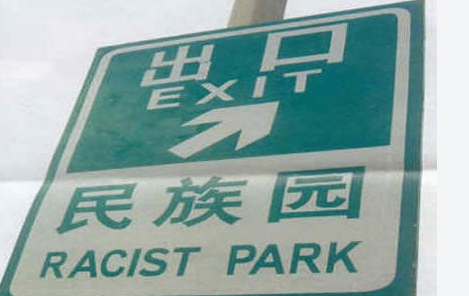
Observe that this road sign was correctly manufactured according to its technical specifications.
For people like Mbappé, this kind of reform and improvement can take decades to really take effect. In the meantime, anyone with very significant economic engagement with China should learn a lesson that they are expected to have expert advice from people who understand these issues.