Recent Chinese laws provide a suite of legal rights against exit bans, on grounds they are an unconstitutional human rights abuse. The law currently authorizes an instrument called a travel restriction order, which is issued by the courts or administrative agencies in furtherance of national security, litigation, and public order. Nonetheless, abuse of power by government bodies and courts is a significant problem, but thankfully there is now expansive legal basis to fight abuse.
A critical problem surrounding China exit bans is the serious misinformation published about this topic. Therefore, we will explain the difference between what Chinese law does authorize, a travel restriction order, and why exit bans are unconstitutional.
Next, this article will offer a two-step process for seeing if any particular travel restriction order in China can be fought as illegal. First, we will look at the legal basis and grounds the agency has for preventing departure from China. Secondly, we will match that basis up with its corresponding option to obtain relief.
Contents
What Is an Exit Ban in China?
When making strategy around exit bans risks, or responding to one, the first step is to clear up the substantial published misinformation. In the Chinese statutes, there is no such thing as an “exit ban,” rather, an exit ban is a human rights law term that refers to a violation of human rights to travel, a famous tactic of the Soviet Union. Let’s look at three questions that are frequently raised about the basics of exit bans in China.
(1) Does China have a law authorizing exit bans?
No. Exit bans are unconstitutional and a human rights abuse, but the fact that government agents may be corrupt and may abuse human rights is real. As we’ll see in more detail, China is constantly passing new regulations that give legal options for fighting unlawful exit bans.
The PRC’s law in this area is derived from the United Kingdom’s laws on travel restriction orders, which is similar to the US federal writ ne exeat republica. In serious situations, there are strict legal rules by which a person can be prevented from going abroad. An illegally made travel restriction order may amount to an exit ban, which is a human rights violation and illegal.
(2) Can exit bans be fought?
Yes. Abusive travel restriction orders in China are public corruption. According to real legal scholars, the reality is China has a long history of abusive exit bans, and this sort of human rights abuse is unconstitutional. (see Bibliography). Non-compliant government agents abused their power and flouted the spirit of numerous sources of law prohibiting exit bans. They were able to exploit shortcomings in the law, because the statutes overbroad on the who and what of applicability, lack of procedural safeguards, and lacked of grounds and options to pursue relief.
There is a distinct bait-and-switch pattern often attempted, where a businessperson is baited to go to China on a short-term visa and then a litigant filed for a travel restriction order. As a result, they are trapped in China but are prohibited from working. This is definitely an illegal tactic and we’ll explain how to fight it on bad faith grounds.
(3) What does the PRC government think of exit bans?
Policy makers and legislative experts strongly condemn exit bans; government officials are not even allowed to say “exit ban” and if you search in gov.cn, you’ll see the only people saying those words are foreign diplomats and journalists. Instead, the party line appears to be, travel restrictions have infringed on fundamental human rights, particularly freedom to travel, which are enshrined in the Chinese constitution. To combat abusive officials, statutes authorize legal action directly against non-compliant governments.
Next, we’ll go over the three steps in analyzing how to resolve an exit ban in China, recalling that under the law, this is actually a travel restriction order.
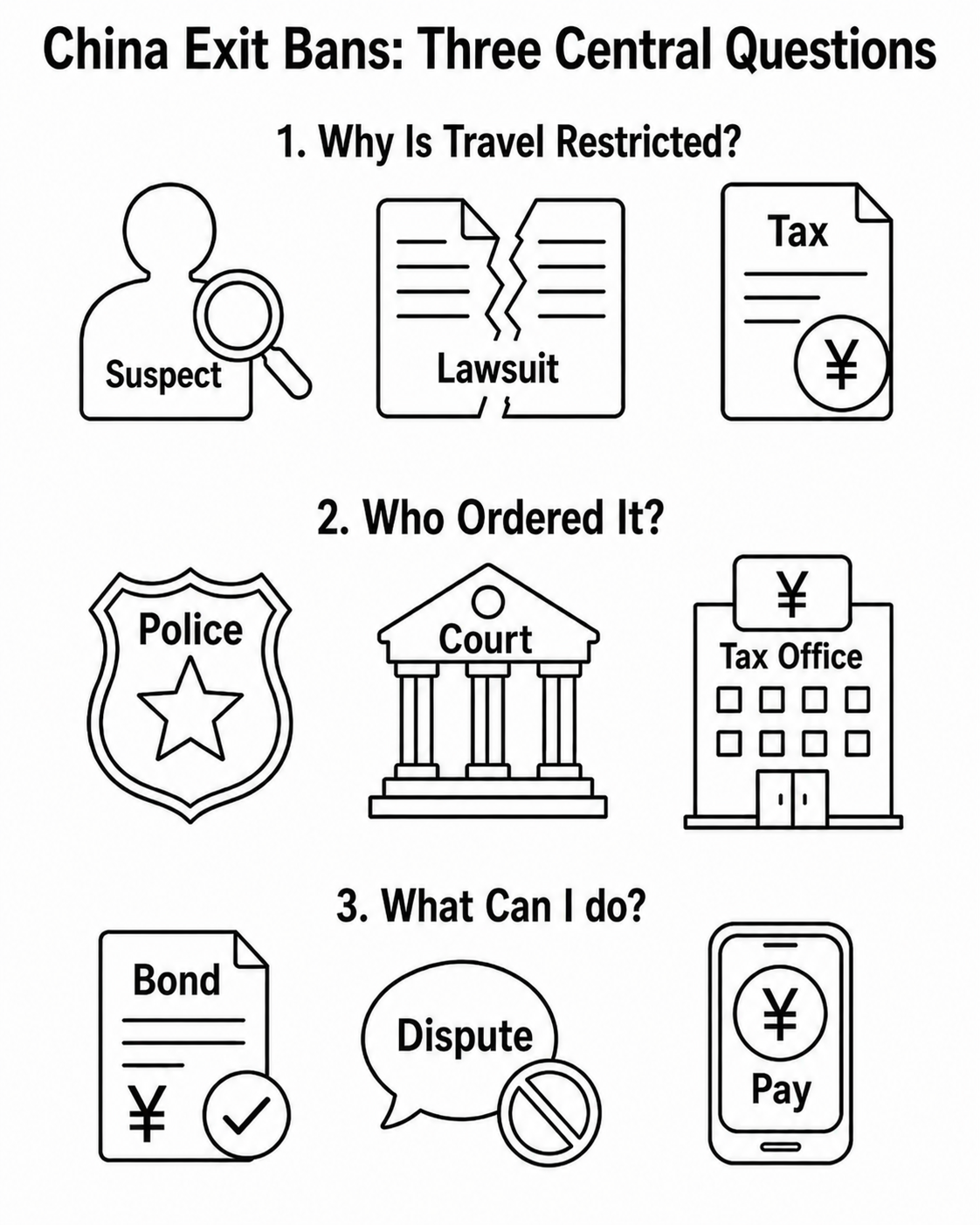
Find Out Why Travel Is Restricted
What travel restriction relief is available depends on the reason and ordering agency. You can find out about a travel restriction in three ways:
- The ordering agency will notify you orally or in writing, typically with the grounds, such as criminal allegations.
- Passport controls; the border control agency sees an applicant is on a no travel list and seizes passports or refuses to grant one to a citizen.
- The border control agency may provide notice when restricting you from leaving the country.
The law does not impose notice obligations on the ordering agency or enforcing agency. Thus, you need to infer the possible reasons for a travel restriction based on what happened in your case. Below, we’ll go over each of the reasons, grouped by the context they appear in.
Criminal. A police agency may impose travel restrictions for criminals with incomplete sentences, a suspect, or defendant. This includes Chinese citizens and foreigners, whether on bail or in detention.[1][2] An immigration agency may issue a travel restriction order for persons who were in an area where telecom fraud originated if the person either: is a suspect, or had a prior telecom fraud criminal record.[3] A trial court may impose travel restrictions or delays on defendants and witnesses to a transnational crime case.[4]
Civil. Travel restrictions may be imposed on any of the following:
- Parties to pending civil litigation, whether Chinese citizens or foreigners, as authorized in the debtor company shareholders and executives to prevent evasion, on motion by a party.[5][6]
- Anyone who may affect performance of a debt. This may be someone subject to an enforcement order for an unperformed agreement, or of an entity, the statutory representative, the responsible person, or an accountable person.[7][8]
- Persons whose travel abroad may frustrate an international litigation or affect evading payment obligations. This can include a statutory representative or responsible person.[9]
Who is a ‘statutory representative’ or ‘responsible person’?
These are legal categories where personal liability may be imposed for business activities, and western executives often sign off on assuming that liability without realizing it. For more details, see CBL’s brief overview of what is statutory representation in Chinese law. Who is a “responsible person” is based on a set of uniform legal principles, which we explain in the context of occupational liability in our article here.
Because these roles in Chinese business law can accidentally be given expansive legal control over the entity, this is an issue requiring strategic decision-making, and you should either understand the law yourself or be advised by a competent attorney. If you need help with these issues, take a look at CBL’s legal services page.
Government Oversight. With the approval of a government oversight agency at or above the provincial level the province government oversight agency may approve imposing travel restrictions on the subject of an investigation and the relevant persons to prevent flight abroad.
Border Control. The border control agency may impose travel restrictions on Chinese citizens who lack valid travel documents or who may evade custom inspections. Chinese citizens who have been found guilty of border control crimes have been deported back to China for illegal crossings, residence, or employment are not permitted to travel outside China for a certain number of years.
Arts. Police agencies cannot issue travel documents to work at foreign gambling and lewd performance establishments. They may impose a five-year travel restriction on persons who worked at such establishments, and the bar for “lewd” is very low—Chinese culture considers some American PG-13 rated content to be pornographic. For example, authorities have declared Chinese nationals’ participation in performances similar to Moulin Rogue as unlawfully obscene (see Time report). Aiding and abetting a violation that occurs outside China can have consequences such as your publications or social media presence being banned within China.[10][11]
Regulatory. A securities regulator may request a police agency to impose travel restrictions on persons implicated in a securities and futures violation.[12] Delinquent taxpayers, or their statutory representative, may be barred from departure by the tax office.[13] Foreigners alleged to have been involved in a hit and run may be prevented from departure by the public safety department.[14]
National Interest and Security. A Chinese citizen may be subject to travel restrictions by if their travel may endanger national security, but only by order at the cabinet level.[15]
Public Corruption Investigations. There are approval procedures where a government oversight during an investigation may issue a travel restriction order against the subject of the investigation and persons relevant to it. For example, GlaxoSmithKline executive Mark Reilly was held as a public corruption witness and suspect.
In any of these cases, to obtain relief, knowing the reason alone is not enough, you need to determine which government body issued the order, i.e. court, tax office, or police.[16]
How to Defeat an Exit Ban
Once we know who ordered it and why, we can see which avenue of relief to take appropriate to the travel restriction order. Below, we’ll go over the various ways in which an order can be overturned according to the context.
Judgment Enforcements
A debtor in default on their agreement is subject to a travel restriction order during enforcement proceedings. This includes their statutory representative, primary responsible person, or an accountable person who can affect the performance of the debt obligations.[7][8]
Trial Courts
This is made in response to a petition for enforcement, or, at the court’s own initiative. The court serves the order on the parties, notifying them of the time limit to request reconsideration.
Error
You may appeal a court-imposed travel restriction order if you believe it was in error, for example due to procedural violation or bad faith.[17] Additionally, you can sue the petitioning counter party or government to claim damages if your legal rights were violated.[18]
Abuse of Power
You may file an appeal if the government body erroneously exercised its power to issue a travel restriction order. You can also file for damages from the government.[17]
Litigation parties may lift the travel restriction by posting sufficient bond or deposit.[19] Government agencies do the same for administrative orders.[9] The law also provides the deposit must equal the amount in controversy, intended to secure enforcement even if the party is outside the country after losing.[17] The legislative intent here was to stop the common phenomenon of large-scale theft followed by flight abroad.
Corruption Regulators
A Chinese province government oversight agency may issue a travel restriction and request police enforcement against persons suspected of public corruption crimes and anyone suspected of criminal bribery, white collar crimes, and anyone relevant to the case. The police agency must be promptly notified of which persons should not be subject to travel restrictions.
Start by determining whether the party discipline agency’s travel restriction order is legal but cooperate with the agency’s investigation. The travel restrictions will be lifted when the investigation subject is cleared of public corruption suspicion. Finally, you are entitled to file a complaint with the agency if the travel restriction order is illegal, for example was originally made or extended without province level agency approval.[20]
Tax Offices
A Chinese tax office may issue a travel restriction order for a delinquent taxpayer or their statutory representative. You can get the travel restriction order lifted by paying back taxes and late fees, or posting a bond to guarantee tax payments.
Police Departments
How police agencies make travel restriction orders. Police obtain travel restriction orders on litigation parties and criminal suspects and assist other government agencies.
You may petition a Chinese police agency directly if it was the one to issue the travel restriction order, which is the case for criminal suspects. The factors considered are possibility of innocence, whether the act constitutes a crime, its severity, and extent of responsibility for the crime. Therefore, you could argue that this act did not constitute a crime, the offense is minor, or that your contribution to an offense was small, therefore they should not take action to restrict your personal freedom.
A police agency may assist another government agency in controlling departure of certain persons. This may constitute administrative assistance, which opens up the option to file for administrative reconsideration or litigation.
Conclusion
Social advances leading to interconnected administrative and judicial information networks mean that travel restriction orders will be more common and expansive. Most government agencies are empowered to create no travel lists and seek police enforcement. If you find you are subject to a travel restriction order, the first steps are to infer which agency did it and why. Then, review each group of reasons we described in this article, and pursue a legal avenue to restore your legal rights, and seek relief from the government agency.
FURTHER READING
Get more insights about Chinese law at CBL’s China Law Library
References
Citations
[1] China Border Control Act § 12(b), (中华人民共和国出境入境管理法), (National Immigration Administration, Jun. 21, 2019), (in Mandarin)
[2] Criminal Procedure Act § 71-72, (中华人民共和国刑事诉讼法), (Ministry of Justice, Dec. 25, 2018), (in Mandarin)
[3] Telecommunications Fraud Act § 36, (中华人民共和国反电信网络诈骗法), (Supreme Procuratorate, Sep. 2, 2022), (in Mandarin)
[4] Criminal Procedure Act Adjudicative Guidelines § 487, (最高法关于适用《中华人民共和国刑事诉讼法》的解释), (Supreme Court, Jan. 26, 2021), (in Mandarin)
[5] China Border Control Act § 12(c), (中华人民共和国出境入境管理法), (National Immigration Administration, Jun. 21, 2019), (in Mandarin)
[6] Supreme Court Opinions on Judicial Assurance and Legal Services for National Economic Security and Sustainable Development, (关于为维护国家金融安全和经济全面协调可持续发展提供司法保障和法律服务的若干意见), (Supreme Court, Dec. 3, 2008), (in Mandarin)
[7] Civil Procedure Act § 266, (中华人民共和国民事诉讼法), (National People’s Congress, Sept. 1, 2023), (in Mandarin)
[8] Supreme Court PRC Civil Procedure Act Enforcement Proceeding Adjudicative Guidelines § 36-37, (最高人民法院《关于适用〈中华人民共和国民事诉讼法〉执行程序若干问题的解释》), (Supreme Court, Nov. 3, 2008), (in Mandarin)
[9] Supreme Court Second National Commercial and Maritime Judicial Conference Report Circular § 93-96, (最高人民法院《第二次全国涉外商事海事审判工作会议纪要》), (China Maritime Law Association, Jul. 17, 2018), (in Mandarin)
[10] Border Control Act § 12(a) and §12(d), (中华人民共和国出境入境管理法), (National Immigration Administration, Jun. 21, 2019), (in Mandarin)
[11] Commerce Ministry, Public Security Ministry, Overseas Gambling and Lewd Performance Prohibition Circular, (商务部、公安部关于严禁向境外博彩色情经营场所派遣劳务人员的通知), (Commerce Ministry and Public Security Ministry, Jun. 30, 2005, text available at Jiangsu Chamber of Commerce for Import and Export Firms), (in Mandarin)
[12] Supreme Court, Prosecutor General Office, Public Security Ministry, China Securities Regulatory Commission, Securities and Futures Crimes Opinions, (最高人民法院最高人民检察院公安部中国证监会关于办理证券期货违法犯罪案件工作若干问题的意见), ((Supreme Procuratorate, May 17, 2024), (in Mandarin)
[13] Tax Administration Act Supplemental Rules § 74, (中华人民共和国税收征收管理法实施细则), (National Taxation Administration, Feb. 6, 2016), (in Mandarin)
[14] Traffic Accident Administrative Procedures § 97, (道路交通事故处理程序规定), (Ministry of Justice, Sept. 19, 2017), (in Mandarin)
[15] Border Control Act § 12(e), (中华人民共和国出境入境管理法), (National Immigration Administration, Jun. 21, 2019), (in Mandarin)
[16] CCP Party Discipline Investigation Agency Rules §34 and §40, (中国共产党纪律检查机关监督执纪工作规则), (General Office of CCP, Jan. 6, 2019, text available at Xinhuanet), (in Mandarin)
[17] Supreme Court Enforcement Opposition and Reconsideration Rules § 9, (关于人民法院办理执行异议和复议案件若干问题的规定), (Supreme Court, May 5, 2015), (in Mandarin)
[18] Supreme Court Letter: Governmental Compensation for Travel Restrictions, (最高人民法院关于限制出境是否属于国家赔偿范围的复函), (Supreme Court, Jun. 4, 2013), (in Mandarin)
[19] Foreign and PRC Citizen Travel Restriction Rules, (关于依法限制外国人和中国公民出境问题的若干规定), (Ministry of Public Security, Mar. 10, 1987, text available at Zhihu), (in Mandarin)
[20] Government Oversight Act § 69(f) and § 74(h), (中华人民共和国监察法), (Supreme Procuratorate, Feb. 5, 2025), (in Mandarin)
Bibliography
The criticism of the Chinese government’s past handling of exit ban cases in this article is derived from the following scholarly publications.
Zhu Jianchao, Jin Xiangping, Jiang Jinliang, “The Law of Travel Restrictions”, People’s Judiciary, 2012(18):107-111.DOI:10.19684/j.cnki.1002-4603.2012.18.030.
Chen Qing’an, “Travel Restrictions in China”, Governance and Law, 2018(09):141-149.DOI:10.15984 j.cnki.1005-9512.2018.09.012.
Liu Zhixin, Dong Lijie, “Improving Litigation Travel Restriction Procedures: Remedies and Relief for Citizens Right to Leave China”, Law and Governance, 2013(11):85-88.
Chen Libo, “Judicial Relief for Departure Restrictions in China”, Journal of Administrative Law, 2010(04):93-98.
Li Na, Yu Xiang, “Travel Restrictions in the Administrative Context”, Journal of North China Electric Power University (Social Sciences Edition), 2010(04):65-69.
Chris Carr & Jack Wroldsen, “Exit Bans When Doing Business in China”, Thunderbird International Business Review (working paper) (2022).